Art and artifacts (or, the case for looking down)
Some of you know I like looking for "arrowheads" as they're commonly known, although most are knives, spears, tools, etc. because archery developed relatively late in Native history. I find them regularly on hikes.
Well, I recently got expert opinions on a few of the ones I've found from Chris Egghart, a retired archeologist writing a book on the subject (which will be free and on the internet). With apologies for my lousy photography, here's a couple of identifications.
 |
| Author pic |
The first pic Chris identified as a Savannah River narrow blade from the Late Archaic period. This is probably a preform, meaning it was never finished by its maker. Or it may have been reworked, which is what people did when a blade became dull. The material is Greywacke. Chris says the favored stone was quartz (since, apparently, our area has little if any of the more useful quartzite), but Greywacke was used here as a stand in when necessary. Hunters had to make do, I guess. It dates from 2500 to 1400 BC. Found in a field by the family farm on Potomac Creek.
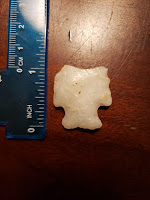
The second is called a Stanley point. It's quartz and from the mid Archaic period, dating from 6200 to 5000 BC. Found in same field.
 |
| Author pic |
Some of the points I've found (no nice individual pictures yet) date back even earlier, including one "Palmer" type of the Early Archaic period (8000-7200 BC). To put that in perspective, the Great Pyramid in Egypt was built in 2600 BC.
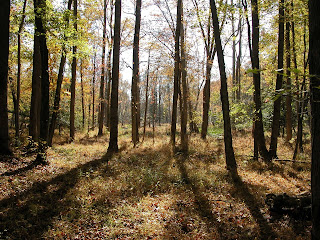
The lesson: Every day, we on Potomac Creek walk over almost unthinkable layers of human and natural history. The evidence is often right on the surface, underfoot. Look down!
Bonus artifact: One
of my favs because of its serrated edges: A LeCroy bifurcate, Early to
Mid Archaic (around 65000 BC).
 |
| Author's pic |
"Consummate upland forest dwellers living
in small groups on terrestrial game and mast," as Chris wrote. "Mast" is seeds, acorns, nuts, etc. Some years trees synchronize to produce enormous amounts all at once. This overwhelms predators like deer and squirrels, ensuring more saplings emerge. I found this point walking the trails of the Rappahannock River in Fredericksburg, maybe seven miles from the creek.
This artifact is about one inch long. Tell me this ancient hunter was not also a remarkable artist. Making something fine out of quartz is nearly impossible -- give it a try! What could he or she have done with Michelangelo's 17-foot high, comparatively soft block of marble?
 |
| Source: Wikipedia |

.jpg)

Comments
Post a Comment